
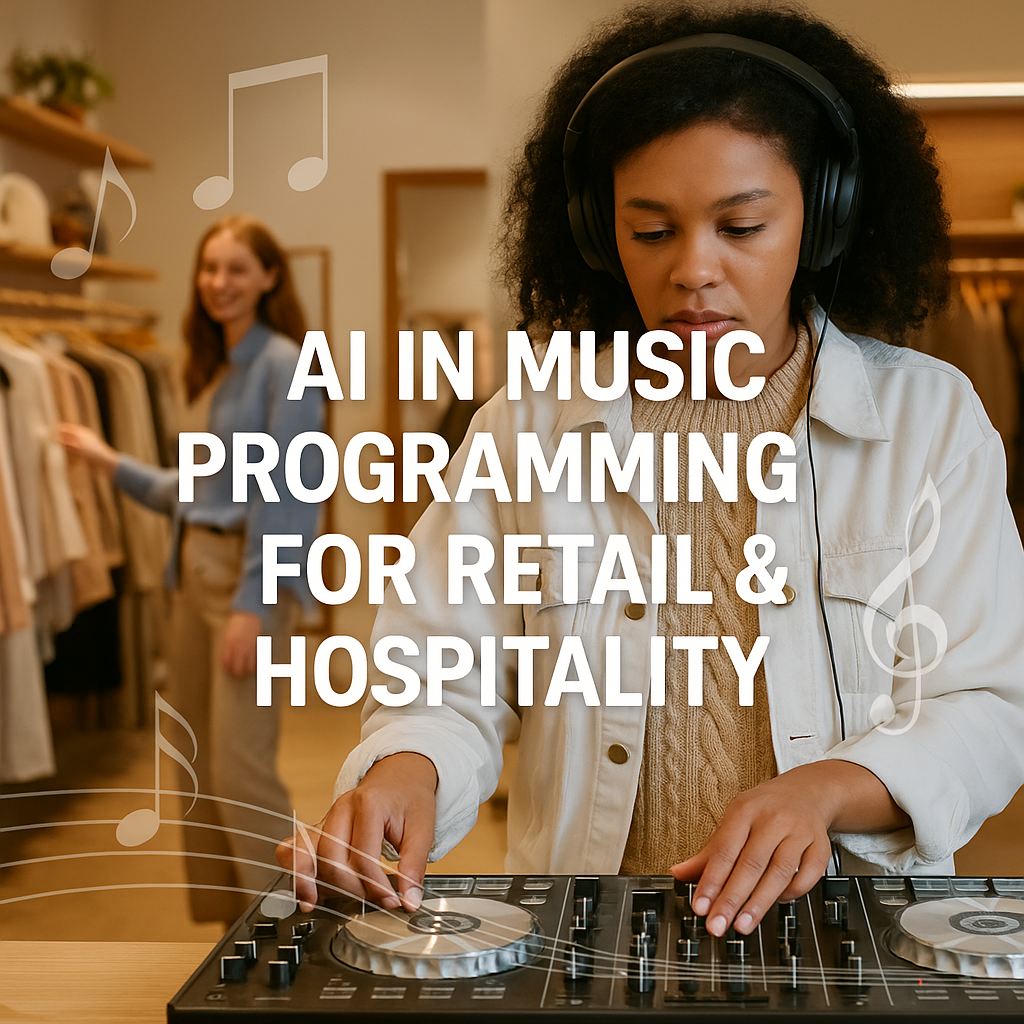
Music has always played a powerful role in shaping how people feel inside commercial spaces. In stores, restaurants, hotels, cafés, spas, and lounges, the soundtrack influences mood, pace, brand perception, and memory. It’s not just there to fill silence. It helps define the experience.
What has changed is how that soundtrack can now be created, managed, refined, and scaled. AI music for retail and hospitality is giving businesses a smarter way to approach one of the most overlooked parts of customer experience. Instead of relying only on static playlists, manual guesswork, or inconsistent store-level choices, brands can now use intelligent systems to build more adaptive, brand-aligned music environments.
That shift matters. Businesses today are under pressure to deliver stronger customer experiences, tighter brand consistency, and better operational efficiency across locations. AI music programming helps address all three. It gives teams better control over mood, pacing, variation, and relevance while reducing the burden of constant manual curation.
For brands that take ambience seriously, this is not a passing trend. It’s a smarter way to manage the sound of physical spaces.
TL;DR: Why AI Music for Retail and Hospitality Matters
AI music helps businesses move beyond generic playlists and inconsistent music choices. It enables more intentional soundtracks based on time of day, audience profile, daypart, energy level, and brand identity. At the same time, AI playlists for business can reduce repetition, improve music flow, support multi-location consistency, and make playlist management more efficient. For businesses that want a more polished and strategic customer experience, AI background music offers a far stronger solution than leaving music to chance.

Why AI Music Is Becoming a Serious Business Tool
Customers don’t experience a business in isolated parts. They experience it as a whole. The décor, service, lighting, layout, sound, and emotional tone all combine into one impression. That impression affects whether a space feels premium, relaxed, welcoming, energetic, elegant, or forgettable.
That is why AI music for retail and hospitality has become more relevant. It helps businesses make music choices with far more precision. Instead of depending only on taste or convenience, brands can use data, metadata, automation, and smarter programming logic to make the soundtrack feel intentional.
In practical terms, that means better alignment between the brand and the customer environment. It means music that changes more appropriately through the day. It means less repetition. It means more consistency across outlets. And it means that sound can finally be managed like the business asset it really is.
1. AI Music Programming for Retail Brings More Strategy to Store Environments
Retail spaces depend heavily on mood and momentum. A store may want a softer, more spacious sound during quieter daytime hours, then a more energised feel during peak shopping periods. That kind of control is difficult to maintain when music is handled informally.
This is where AI music programming for retail becomes valuable. It allows businesses to create more strategic music flows based on pace, energy, customer profile, and the type of shopping experience they want to encourage. Rather than using random playlists or a one-size-fits-all approach, teams can shape the music more deliberately.
Good music programming for retail also helps stores sound more consistent with their brand identity. A premium fashion retailer, a beauty store, and a home furnishing brand shouldn’t all sound the same. Intelligent programming helps create those distinctions in a way that feels thoughtful rather than mechanical.
2. AI Music Programming for Hospitality Helps Shape Atmosphere More Precisely
Hospitality environments live and die by how they feel. Guests respond not only to service and interiors, but to tone, warmth, comfort, and ambience. Music is central to that. A hotel lobby, restaurant, spa, or lounge often needs a different sound depending on the hour, guest mix, and intended mood.
That is why AI music programming for hospitality is becoming increasingly useful. It allows venues to create more refined sonic shifts across breakfast, lunch, dinner, evening service, weekend periods, or quieter relaxation windows. It can support calm, elegance, warmth, sophistication, or energy without forcing teams to rebuild playlists manually every time.
At its best, music programming for hospitality makes the environment feel more intentional. It helps the music move with the guest journey instead of sitting in the background as an afterthought.
3. AI Background Music Reduces Repetition
Repetition is one of the fastest ways to weaken a music experience. Staff hear it first because they are exposed to it all day, but customers pick up on it too. When the same tracks, artists, or moods cycle too often, the space begins to feel lazy and less considered.
This is one of the strongest practical advantages of AI background music for retail and hospitality. Intelligent systems can manage song spacing, artist separation, tempo flow, mood variation, and recurrence patterns more effectively than a simple static playlist. That means better freshness without losing the intended atmosphere.
For brands that want a consistent but not monotonous environment, AI background music offers a better balance between familiarity and variety.
4. AI Playlists for Business Improve Efficiency Without Making Music Feel Robotic
Many businesses assume that automation will make music feel generic. In reality, the opposite can happen when the system is designed properly. Strong AI playlists for business are not about removing taste. They are about improving scale, consistency, and decision-making.
Teams no longer need to spend endless time manually updating playlists for every daypart, season, or outlet. Managers don’t need to guess whether the soundtrack is still aligned to the space. With well-built AI playlists for business, brands can automate much of the operational work while still retaining control over the music direction.
That saves time, reduces inconsistency, and makes high-quality programming more sustainable.
5. AI Music for Retail and Hospitality Supports Stronger Brand Identity
A brand is not only seen. It is felt. That feeling comes partly from music.
AI music helps brands align soundtrack decisions with identity, audience, and positioning. A premium boutique may need sleek, modern tracks with confidence and restraint. A family dining venue may need warmth and familiarity. A wellness environment may require calm, softness, and space. A hotel bar may want understated sophistication that gradually builds energy as the evening develops.
When the soundtrack matches the brand properly, the whole customer experience feels more coherent. The right music helps make that possible with greater consistency across time periods and locations.
6. AI Music Programming Allows Better Daypart Control
One of the great advantages of intelligent systems is that they can handle change more elegantly. The right music at 10 a.m. is not always the right music for 7 p.m. The right mood for weekday lunch is not always right for weekend dinner. The business context changes, and the soundtrack should too.
That is where AI music programming for retail and AI music programming for hospitality become especially powerful. Both allow businesses to adapt music according to time, traffic, audience expectation, and commercial purpose. Instead of staying stuck in one sonic mode, the space can evolve naturally through the day.
This matters because customers are sensitive to atmosphere even when they’re not consciously analysing it. Better daypart control creates a more polished experience.
7. AI Background Music for Retail and Hospitality Helps Multi-Location Brands Stay Consistent
Multi-site businesses face a difficult challenge. They need brand consistency, but they also need flexibility. A flagship city store may not need exactly the same music flow as a smaller suburban store. A resort restaurant may need a different mood from an urban business hotel. Yet the overall brand still needs to feel recognisable.
AI background music helps solve that tension. It allows central control over brand rules while giving room for variation based on location type, audience rhythm, and trading pattern. That means businesses can maintain standards without forcing every outlet into the exact same musical identity.
For growing brands, this is a major advantage, as it makes it easier to scale ambience without losing quality.
8. AI Playlists for Business Can Use Better Metadata to Make Better Decisions
The quality of music programming depends heavily on the quality of classification behind it. If tracks are tagged only by broad genre labels, the results are often too blunt. But when music is understood in more detail, decisions become much sharper.
This is one reason AI playlists can be so effective. They can use richer metadata such as mood, tempo, instrumentation, vocal intensity, era, texture, and emotional tone. That makes it easier to build a precise soundtrack rather than a generic one.
For example, a business may not just want jazz or pop. It may want warm acoustic pop with low vocal intensity for a daytime café, or elegant downtempo textures for a luxury spa. Better AI driven metadata gives the business the ability to handle those distinctions more intelligently.
9. AI Music for Retail and Hospitality Is Opening the Door to Smarter Future Models
The future of commercial music is likely to be more adaptive, more measurable, and more integrated. That includes not just intelligent curation, but also better rights management, improved licensing workflows, and new possibilities in AI-assisted music creation.
In that larger picture, AI music for retail and hospitality is part of a broader evolution. Businesses want more control, more consistency, and more commercially suitable music options. They also want greater flexibility in how music is sourced and managed. AI makes that increasingly possible.
This does not mean replacing human judgement. It means giving creative and operational teams better tools. The most effective use of AI music in retail and hospitality is not to remove human taste, but to sharpen it.
What Businesses Should Look for in AI Music Programming
Not every solution is equally useful. The strongest systems usually combine technology with clear brand understanding. When evaluating AI playlists for business, brands should look for a few important qualities.
AI Music Programming for Retail Should Match Store Identity
The system should be able to reflect the character of the retail environment, not just provide generic commercial music. Strong AI music programming for retail should support different store formats, customer profiles, and trading periods.
AI Music Programming for Hospitality Should Reflect Guest Experience
The hospitality journey is highly emotional, so AI music programming for hospitality should feel refined, flexible, and responsive to the setting. It should support ambience, not fight it.
AI Playlists for Business Should Be Easy to Manage at Scale
The operational side matters too. Good AI playlists for your business should make life easier for teams, not more complicated. They should simplify programming across locations while keeping music standards high.
Final Thoughts on AI Music for Retail and Hospitality
Music has always mattered in physical business environments, but the way it’s managed is changing fast. AI music playlists give brands a more intelligent way to shape atmosphere, reinforce identity, reduce repetition, and improve the consistency of customer experience.
At the same time, AI music programming for retail, AI music programming for hospitality, and AI playlists for business show that this is not just about automation for its own sake. It’s about using smarter tools to create better commercial environments. And when done properly, AI background music for retail and hospitality helps make a business feel more polished, more thoughtful, and more aligned with what customers expect.
That is why this matters. Music is not a minor operational detail. In retail and hospitality, it’s part of the experience itself.
FAQ: AI Music for Retail and Hospitality
What is AI music for retail and hospitality?
AI music for retail and hospitality refers to the use of intelligent systems to curate, schedule, adapt, and optimise music for commercial environments such as stores, restaurants, hotels, cafés, spas, and lounges.
How is AI music programming for retail different from ordinary store playlists?
AI music programming for retail is more strategic and adaptive. It can use mood, tempo, time of day, customer profile, and store identity to build a more suitable soundtrack than a static playlist.
Why is AI music programming for hospitality useful?
AI music programming for hospitality helps venues shape atmosphere more precisely across different guest journeys, service periods, and venue types, making the environment feel more intentional and refined.
What is the benefit of AI background music for retail and hospitality?
AI background music for retail and hospitality can reduce repetition, improve flow, support brand consistency, and create a better overall experience for both customers and staff.
Are AI playlists for business only useful for large brands?
No. AI playlists for business can help both single-site and multi-location businesses by improving music quality, consistency, efficiency, and ease of management.